
Light as Medicine: Why Incandescent Bulbs Charge Our Mitochondria – and LEDs Quietly Weaken Them

A deep dive for LichtundKlang.us – based on cutting-edge science, the Huberman Lab A deep dive for LichtundKlang.us – based on cutting-edge science, the Huberman Lab podcast, and the “wild theory” that’s now going mainstream
What if the light bulbs in your home directly affect your cellular energy? Neuroscientist Dr. Andrew Huberman and Prof. Glen Jeffery (University College London) say exactly that. Long-wavelength light (red, near-infrared, infrared) from incandescent bulbs and sunlight boosts mitochondria, improves metabolism, blood sugar control, and even eyesight. Modern short-wavelength-heavy LEDs, without balance, can impair mitochondrial function.The viral X-post by
@VigilantFox
(March 2026) with millions of views brought this topic into the spotlight — and the science now backs it.How Light Affects Your CellsMitochondria — the powerhouses of your cells — are light-sensitive.
Long wavelengths (620–1000 nm+): Absorbed by cytochrome c oxidase → more ATP, less oxidative stress, better energy and vision.
Short wavelengths (especially 420–450 nm blue from LEDs): Can suppress mitochondrial respiration when not balanced by red/infrared light.
Huberman Lab episode (Dec 1, 2025) with Glen Jeffery: “Red and infrared light enhance mitochondrial function systemically. LEDs heavy on short wavelengths without counterbalance can damage it.”
Key Studies
2025 – “Longer wavelengths in sunlight pass through the human body” (Scientific Reports): Just 15 minutes of sunlight (even fully clothed) improves mitochondrial function and vision systemically.
2026 – “LED lighting (350-650nm) undermines human visual performance” (Scientific Reports): In a windowless office, switching away from standard LEDs significantly improved color contrast vision in all participants — because missing long wavelengths had suppressed retinal mitochondria.
Additional findings: A short 670 nm red light exposure can reduce post-meal blood glucose spikes by up to 27% and improve vision for days.

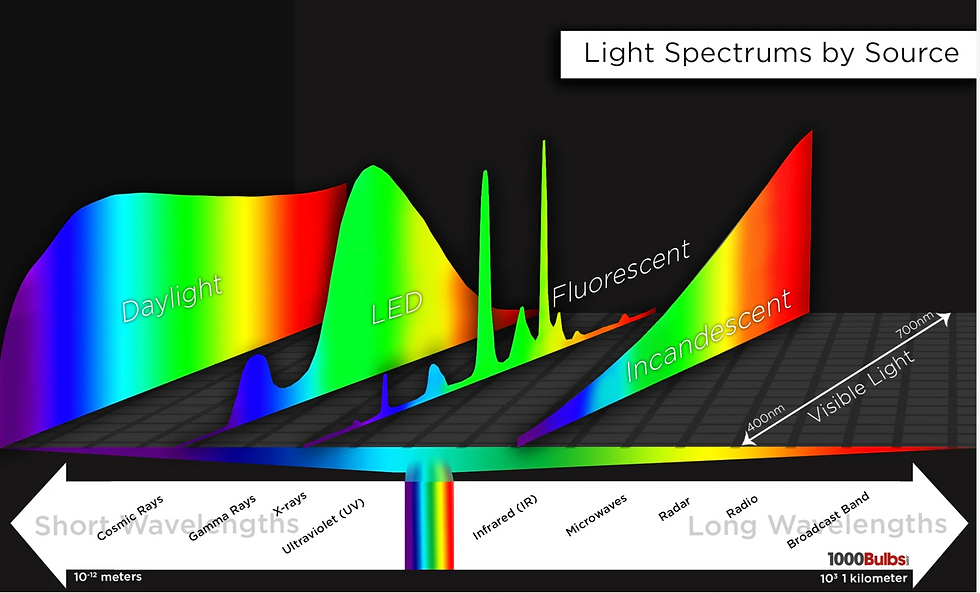
Incandescent vs. LED SpectrumTraditional incandescent bulbs emit a continuous full spectrum rich in red and infrared — ideal for biology. LEDs are efficient but often heavily blue-dominant.

Practical Tips
Get morning sunlight for 10–15 minutes — the best full-spectrum source.
Use warm incandescent or Edison-style bulbs (2200–2700 K) indoors, especially in the evening.
Try red/near-infrared light therapy (670 nm or broad NIR panels) for 3–10 minutes daily.
Dim lights and avoid bright blue screens at night.
Combine with sound: Pair red light sessions with 432 Hz or 528 Hz frequencies for deeper resonance.
High-CRI full-spectrum LEDs are better than cheap ones, but real sunlight and incandescents remain superior.TakeawayLight is primary cellular nutrition. We optimized bulbs for energy efficiency and ignored biological consequences. By choosing the right wavelengths, you can support your mitochondria, energy levels, and overall vitality — perfectly in tune with sound and frequency work.Once called conspiracy — now solid science.Sources & Further Reading
Huberman Lab Podcast: “Using Red Light to Improve Metabolism & the Harmful Effects of LEDs” with Dr. Glen Jeffery (Dec 1, 2025) → https://www.hubermanlab.com/episode/red-light-to-improve-metabolism-and-harmful-effects-of-led-glen-jeffery
Jeffery et al., “Longer wavelengths in sunlight pass through the human body…” Scientific Reports, 2025 → https://www.nature.com/articles/s41598-025-09785-3
Barrett & Jeffery, “LED lighting (350-650nm) undermines human visual performance…” Scientific Reports, 2026 → https://www.nature.com/articles/s41598-026-35389-6
Have you switched to warmer lighting or tried red light therapy? Share your experience in the comments!Stay vibrating with Light & Sound.
Your LichtundKlang Team


